

Morning Yoga: Complete Beginner Routine to Start Your Day Right
Discover a gentle morning yoga routine perfect for beginners. Simple poses, clear instructions, and tips to make yoga your daily habit.
Équipe Retreat And Be
Editorial content produced and reviewed by the Retreat And Be team.
Introduction
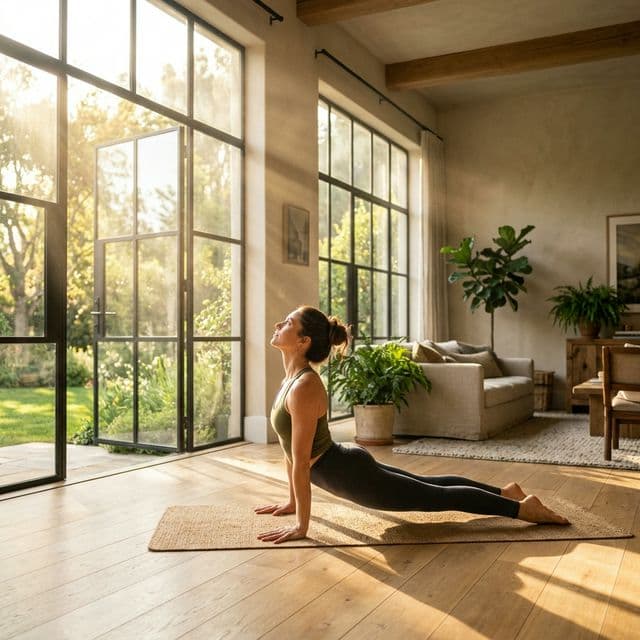
Imagine starting each day feeling calm, energized, and present. No frantic rush, no groggy struggle—just a gentle awakening of body and mind.
Morning yoga makes this possible, and you don't need to be flexible, athletic, or experienced. You just need 15 minutes and a willingness to begin.
This guide provides everything you need: a complete beginner routine, clear instructions, and tips to make morning yoga a sustainable habit.
Why Morning Yoga?
Benefits of Practicing in the Morning
Starting your day with yoga offers unique advantages:
Physical Benefits
- Gently awakens stiff muscles
- Increases circulation after sleep
- Boosts metabolism for the day
- Improves posture for hours ahead
Mental Benefits
- Sets calm, focused tone
- Reduces morning anxiety
- Creates space before daily demands
- Builds consistency (fewer schedule conflicts)
Energetic Benefits
- Natural energy without caffeine
- Balances nervous system
- Promotes alertness without jitteriness
- Connects you to your body before screens
Common Concerns Addressed
"I'm not flexible" Yoga creates flexibility; it doesn't require it. Every pose can be modified.
"I don't have time" 15 minutes. That's a scroll through social media. You have time.
"I don't know what I'm doing" This guide walks you through every step. Follow along.
"My body is stiff in the morning" Perfect—morning yoga specifically addresses this. Start gentle.
Preparing for Your Practice
What You Need
Essential
- A quiet space (enough room to stretch your arms)
- Comfortable clothing (can be sleepwear)
Helpful but Optional
- Yoga mat (carpet or rug works)
- Blanket for cushioning
- Block or thick book for support
- Glass of water nearby
Before You Begin
- Visit the bathroom first
- Wait 30 minutes after eating
- Keep room slightly cool (aids wakefulness)
- Silence phone or put in another room
The 15-Minute Morning Routine
Follow this sequence exactly as written. Each pose includes beginner modifications.
- 1
Centering (1 minute)
How: Sit comfortably (cross-legged or on heels). Close eyes. Take 5 slow breaths. Notice how your body feels without judgment.
**Why**: Transitions you from sleep to presence. Sets intention for practice. **Tip**: You can do this sitting on the edge of your bed before moving to your mat. - 2
Cat-Cow (2 minutes)
How: Come to hands and knees. Inhale: drop belly, lift gaze (Cow). Exhale: round spine, tuck chin (Cat). Flow between these 10-12 times.
**Why**: Gently mobilizes spine, releases back tension, warms core. **Modification**: Keep movements small if stiff. Pad knees with blanket. - 3
Child's Pose (1 minute)
How: From hands and knees, sit back toward heels, arms extended forward. Rest forehead on mat. Breathe into back body.
**Why**: Gentle stretch for hips, thighs, back. Calming, grounding. **Modification**: Place pillow between calves and thighs if knees uncomfortable. Keep arms by sides if shoulders tight. - 4
Downward Dog (1 minute)
How: From Child's Pose, tuck toes, lift hips high. Form inverted V shape. Pedal feet, bend knees as needed.
**Why**: Lengthens hamstrings, calves, spine. Energizes. **Modification**: Keep knees bent generously. Focus on lengthening spine, not straight legs. Walk feet wider. - 5
Forward Fold (1 minute)
How: Walk feet to hands. Fold over legs, knees bent. Grab opposite elbows, sway gently.
**Why**: Releases hamstrings, decompresses spine, calms nervous system. **Modification**: Knees as bent as needed. Don't force straight legs. Rest hands on block. - 6
Mountain Pose (30 seconds)
How: Roll up slowly, one vertebra at a time. Stand tall, feet hip-width, arms by sides. Ground through feet, lengthen crown upward.
**Why**: Establishes alignment, builds awareness, promotes good posture. **Tip**: Notice the difference in how you feel compared to when you started. - 7
Sun Salutation A Modified (4 minutes)
Complete 3-4 rounds of this modified sequence:
1. **Reach up**: Inhale, raise arms overhead 2. **Fold forward**: Exhale, bend knees, fold over legs 3. **Halfway lift**: Inhale, flat back, hands on shins 4. **Fold**: Exhale, release down 5. **Step back to plank**: (or Lower to knees for Tabletop) 6. **Lower down**: Exhale, knees-chest-chin or full Chaturanga 7. **Cobra**: Inhale, low backbend, shoulders back 8. **Downward Dog**: Exhale, lift hips, 3 breaths 9. **Walk feet forward**: Step to hands 10. **Rise up**: Inhale, reach arms, look up 11. **Mountain**: Exhale, hands to heart **Modification**: Move slowly. Skip any uncomfortable elements. Quality over speed. - 8
Gentle Twist (2 minutes)
How: Sit or lie down. Cross right knee over left, look over right shoulder. Hold 1 minute each side.
**Why**: Detoxifies, releases lower back, balances nervous system. **Modification**: Keep bottom leg straight if tight. Don't force the twist. - 9
Final Rest (2 minutes)
How: Lie flat on back, legs extended, arms by sides, palms up. Close eyes. Release all effort.
**Why**: Integrates practice benefits. Allows nervous system to absorb changes.

**Tip**: Set a gentle alarm if worried about falling back asleep. Even 2 minutes of Savasana matters.
Making It a Habit
The First Week
Don't aim for perfection—aim for consistency:
- Days 1-3: Do the full routine even if sloppy
- Days 4-5: Start noticing what feels good/challenging
- Days 6-7: Begin refining poses slightly
The First Month
Build the foundation:
- Same time daily (as close as possible)
- Same location (triggers habit)
- Track your practice (simple checkmarks help)
- Be patient with progress
When You Miss a Day
And you will:
- Don't double up the next day
- Don't criticize yourself
- Just return to your routine
- One missed day means nothing; quitting does
Common Beginner Mistakes
Mistake 1: Going Too Fast
Problem: Rushing to "finish" the routine Solution: Yoga isn't exercise to complete; it's awareness to practice. Slower is better.
Mistake 2: Comparing to Others
Problem: Feeling inadequate watching flexible yogis online Solution: Your yoga is YOUR yoga. Progress is measured against your yesterday, not someone else's today.
Mistake 3: Skipping Savasana
Problem: Jumping up immediately after the last pose Solution: Final rest is essential—it's when benefits integrate. Never skip it.
Mistake 4: Holding Your Breath
Problem: Forgetting to breathe in challenging poses Solution: If you can't breathe smoothly, back off the pose. Breath is more important than depth.
Progressing Your Practice
After 1 Month
As poses become familiar:
- Add 5 minutes to practice
- Explore deeper variations
- Hold poses longer
- Reduce modifications as comfortable
After 3 Months
Consider:
- Attending a beginner class (online or in-person)
- Learning new poses to add variety
- Exploring different styles (Vinyasa, Hatha, Yin)
- Deepening understanding of alignment
Keep It Fresh
Prevent boredom:
- Change music occasionally
- Practice outside when possible
- Try evening yoga sometimes
- Add poses that interest you
FAQ: Morning Yoga Questions
Should I eat before morning yoga?
Light practice is fine on an empty stomach and often preferable. If you're hungry, have something small (banana, few nuts) 30+ minutes before. Avoid full meals.
What if I feel sore or tight?
Morning stiffness is normal. Move gently, use modifications liberally, and let your body warm gradually. Pain (not discomfort) means back off or skip that pose.
Can I do yoga every day?
Yes! This gentle routine is safe for daily practice. Listen to your body—if genuinely exhausted, rest. But "not feeling like it" isn't the same as needing rest.
What if I only have 5 minutes?
Do Cat-Cow, Downward Dog, and Forward Fold. Or just 5 minutes of slow breathing with gentle stretching. Something beats nothing.
Conclusion: Your Morning Transformation
You don't become a "morning yoga person" by magic. You become one by showing up, day after day, especially when you don't feel like it.
Start tomorrow. Set your mat out tonight. When the alarm goes, don't think—just move to your mat and begin.
In a month, you'll feel different. In three months, you'll look different. In a year, you'll wonder why you ever started your days any other way.
Your body is waiting. Your practice is ready. All that's missing is your first step.
Deepen Your Yoga Journey
Ready to take your practice further? Our beginner-friendly yoga retreats offer immersive learning in beautiful settings with expert instructors who meet you where you are.
Explore Yoga RetreatsKeywords
Ready to transform your wellbeing?
Join thousands who have already started their wellness journey with Retreat & Be.
Start