

Meditation for Beginners: Complete Guide to Starting Your Practice
Want to start meditating but don't know where to begin? This practical guide will teach you the basics, techniques, and tips to establish a lasting practice.
Équipe Retreat And Be
Editorial content produced and reviewed by the Retreat And Be team.
Introduction
You've heard about the benefits of meditation everywhere: stress reduction, better focus, improved sleep... But when you try, your mind races, you get bored after 2 minutes, and you wonder if you're "doing it right."
Good news: this is completely normal. Meditation isn't about having no thoughts—it's about changing your relationship with them.
What is Meditation Really?
The Misconception
Many people imagine meditation as a state of complete mental emptiness, sitting cross-legged for hours. This image is intimidating and... false.
The Reality
Meditation is simply training your attention. Like going to the gym for your muscles, you train your mind to:
- Notice when it wanders
- Gently bring it back to a focal point
- Do this again and again, without judgment
The goal isn't to have no thoughts. It's to become aware of them and choose where to direct your attention.
Why Start Meditating?
Scientifically Proven Benefits
Research confirms what practitioners have known for millennia:
- Stress reduction: Decreases cortisol, the stress hormone
- Better focus: Strengthens the ability to concentrate
- Improved sleep: Helps calm the mind before bed
- Emotional management: Creates space between stimulus and response
- Reduced anxiety: Lowers ruminative thoughts
What You Can Expect
- 1
First weeks
Frustration is normal. Your mind wanders constantly. The key is to come back, again and again.
- 2
After 1 month
You start to notice moments of calm. Outside of sessions, you're a bit more present.
- 3
After 3 months
The practice becomes natural. You feel the difference if you skip a day.
- 4
Long term
Meditation becomes a foundation of your daily life. Stress affects you less.
How to Start: 5 Simple Steps
1. Choose your moment
The best time is the one that works for YOU. That said:
- Morning: Starts the day calmly, before distractions
- Evening: Decompresses after the day, prepares for sleep
- During a break: Resets the mind between tasks
2. Find your spot
No need for a zen room. Just somewhere you can:
- Sit comfortably
- Not be disturbed for a few minutes
- Feel relatively calm
3. Adopt a comfortable position
- Seated on a chair: Feet flat, back straight but not rigid
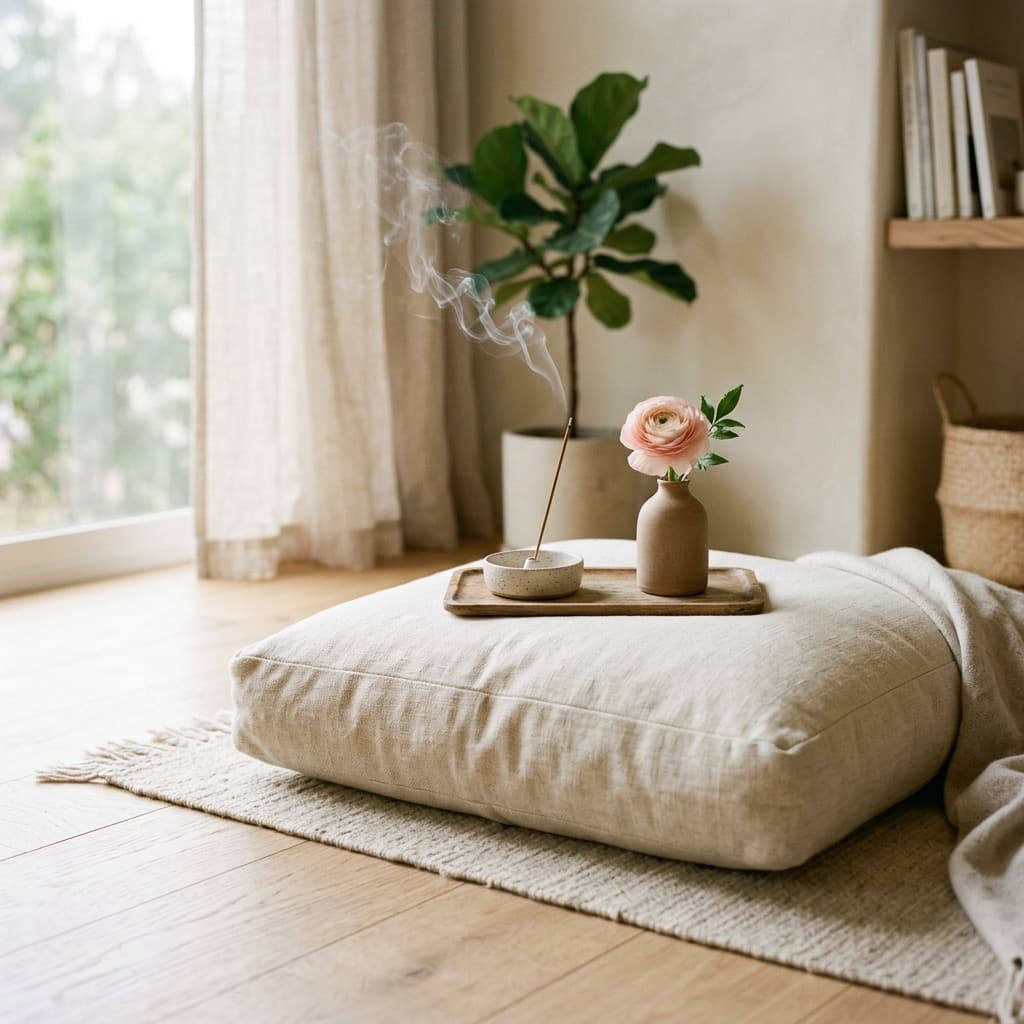
- On the floor: Cushion under the buttocks, legs crossed or stretched
- Lying down: Good for relaxation, but you might fall asleep
The important thing: a position you can hold without pain.
4. Start short
5 minutes is perfect for starting. Forget hour-long sessions. Regularity beats duration.
5. Be patient with yourself
Your mind will wander. That's not failure—that's the practice. Each time you notice and return, you're training your attention.
3 Simple Techniques for Beginners
Breath observation
The most accessible technique:
- Close your eyes or soften your gaze
- Breathe naturally
- Notice the sensation of breath (nostrils, chest, belly)
- When your mind wanders, gently come back to the breath
- Repeat, without judgment
Body scan
Ideal for reconnecting with bodily sensations:
- Lie down or sit comfortably
- Mentally scan your body from feet to head
- Notice sensations in each area (tension, warmth, nothing...)
- Don't try to change anything, just observe
Guided meditation
Perfect for starting:
- A voice guides you through the practice
- Easier to stay focused
- Many apps and videos available
Common Mistakes to Avoid
Forcing to feel nothing
Thoughts will come. The goal is to observe them without engaging, like watching clouds pass.
Being too rigid
If a position hurts, change it. If 10 minutes is too long, do 5. Adapt the practice to yourself.
Expecting immediate results
Meditation is a long-term training. Benefits come gradually, often without you noticing at first.
FAQ
How long should I meditate?
Start with 5 minutes daily. Regularity is more important than duration. Once you
Is it normal if I can't stop thinking?
Absolutely! The mind produces thoughts, that
Should I use an app?
For beginners, guided apps (Headspace, Calm, Petit Bambou, Insight Timer) are excellent. They structure the practice and make it accessible.
When will I see results?
Some feel effects after a few sessions (calmer), others after several weeks. On average, studies show benefits after 8 weeks of regular practice.
Conclusion
Meditation isn't a mystical practice reserved for yogis. It's a simple, accessible exercise that anyone can integrate into their daily life.
Start today: 5 minutes, sitting comfortably, observing your breath. That's all you need.
The hardest part? Taking that first step. You've just taken it by reading this.
Go further with guided sessions
Retreat & Be offers meditation programs adapted to each level. Start your journey today.
Discover our meditationsKeywords
Ready to transform your wellbeing?
Join thousands who have already started their wellness journey with Retreat & Be.
Start