


Connexion
Back to blog
business-wellness
6 min

Yoga Class Schedule: How to Build a Profitable Timetable

Optimize your class schedule to maximize attendance and profitability. Strategic time slots, class types, and balancing supply with demand.

Équipe Retreat And Be

Editorial content produced and reviewed by the Retreat And Be team.
Yoga Class Schedule: How to Build a Profitable Timetable

Introduction

You have 40 slots per week. Some are fully booked, others are empty. You're hesitant to add a prenatal yoga class but don't know where to fit it. And your instructors are complaining about the hours.

Building a profitable schedule is an art that combines data, market intuition, and human resource management. This guide gives you the keys to succeed.

Principles of an Effective Schedule

Supply-Demand Balance

Classic mistake: Offering too many classes "just in case" with empty rooms, or not enough and losing frustrated clients.

Right approach:

  • Analyze your current attendance
  • Identify demanded but unserved time slots
  • Remove or move underperforming classes
  • Add progressively (test → validate → make permanent)

Balanced Diversity

A good schedule offers:

  • Different yoga types (dynamic, gentle, specialized)
  • Different levels (beginner, intermediate, advanced)
  • Different durations (45min, 60min, 90min)
  • Different instructors (varied styles)

Without going overboard: too much variety = confusion.

Temporal Consistency

Clients love routine:

  • Same class, same day, same time every week
  • Avoid frequent changes
  • If change is necessary, communicate well in advance

Analyzing Demand by Time Slot

Key Time Slots

  1. 1

    Early Morning (6am-8am)

    Profile: Working people who want to practice before work Demand: Strong in business/urban areas Class types: Dynamic, energizing (vinyasa, power yoga) Watch out: Your availability and your instructors'

  2. 2

    Mid-Morning (9am-11am)

    Profile: Retirees, freelancers, parents (kids at school) Demand: Moderate but loyal Class types: Hatha, yin, gentle yoga Watch out: Often underexploited slot

  3. 3

    Lunch (12pm-2pm)

    Profile: Working people on lunch break Demand: Variable by area (strong downtown) Class types: Express (30-45min), all levels Watch out: Punctuality is crucial

  4. 4

    After-Work (5:30pm-8pm)

    Profile: Working people after work Demand: Very strong, premium slots Class types: Varied, all levels Watch out: High competition, limited capacity

  5. 5

    Weekend

    Profile: Varied (families, working people catching up) Demand: Strong Saturday morning, weaker Sunday Class types: Workshops, longer formats, family Watch out: Opportunity for special offers

Map Your Area

Your clientele depends on your location:

  • Downtown / Business district: Strong early morning and lunch
  • Residential neighborhood: Strong mid-morning and weekend
  • Suburban area: Strong after-work and weekend

Adapt your schedule to your local reality.

Building Your Grid

5-Step Method

  1. 1

    List Your Available Slots

    Opening hours × number of rooms × 7 days = available slots.

    Example: 12h open × 2 rooms × 6 days = 144 max slots.
    
  2. 2

    Identify Premium Slots

    The must-haves: after-work, Saturday morning. These slots should be filled with your most popular classes.

  3. 3

    Place the "Locomotive" Classes

    Your most requested classes, with your best instructors, on premium slots.

  4. 4

    Fill in with Diversity

    Specialized classes, new formats, on secondary slots. This is where you can test.

  5. 5

    Leave Slots Empty

    Don't fill everything! Keep flexibility for: - Workshops and events - Space rental - Instructor rest - New class tests

Sample Schedule (1 room)

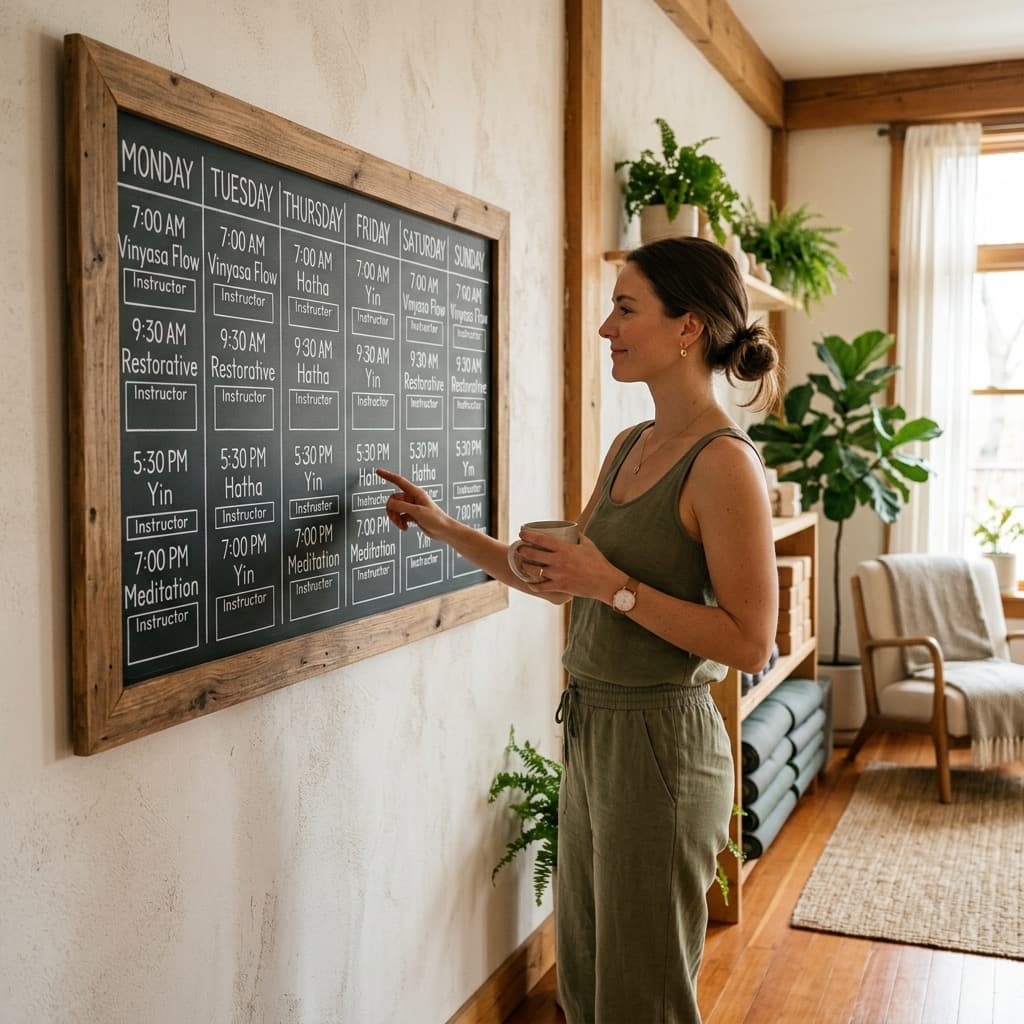
TimeMondayTuesdayWednesdayThursdayFridaySaturday
7amVinyasa-Power-Vinyasa-
9:30amHathaYinHathaPilatesHathaVinyasa
12:15pmExpressExpress-Express--
6pmBeginner YogaVinyasaHathaYin--
7:15pmVinyasaHathaVinyasaHathaYoga Date-

The Instructor Team

Build a Complementary Team

  • Varied profiles (styles, personalities, available hours)
  • Mix of full-time and part-time
  • Specialized skills (prenatal, seniors, etc.)

Manage Instructor Schedules

Constraints:

  • Personal availability
  • Commute time
  • Fatigue (not too many back-to-back classes)
  • Fairness (premium slot distribution)

Tools:

  • Scheduling software (integrated with your booking system)
  • Clear communication of rules
  • Advance planning (1 month minimum)

Substitution

Always have:

  • A list of qualified substitutes
  • Clear processes (notice period, client communication)
  • A Plan B for emergencies

Test and Adjust

The Test Rule

Every new class = test period:

  • Duration: 6-8 weeks minimum
  • Goal: X% attendance
  • If achieved: make permanent
  • If not: adjust (time, format) or remove

Signals to Watch

When to Modify the Schedule

  • Seasonal change: Adapt to January (rush) and July (slow)
  • Repeated feedback: Clients request a specific slot
  • Clear data: A class has underperformed for 2+ months
  • Opportunity: New star instructor, new trend

Special Cases

Launching a Studio

Start light:

  • 15-20 classes/week maximum
  • Focus on premium slots
  • Add progressively based on demand
  • Avoid exhausting yourself with an overly ambitious schedule

Expansion

When to add classes:

  • Regular waitlist on certain slots
  • Explicit unmet demand
  • New client profiles to capture
  • New instructor to integrate

Reduction

When to remove classes:

  • Attendance <30% for 2+ months
  • Net financial loss (instructor cost > revenue)
  • Free up time for more profitable formats

FAQ

How many classes per week for a yoga studio?

Depends on your size and market. Small studio: 20-30 classes. Medium studio: 40-60 classes. Large center: 80+ classes. The right number balances attendance and profitability.

Should I offer classes every day?

Not necessarily. One closure day (often Sunday) allows rest, cleaning, and sometimes private events. Evaluate local demand before opening 7 days.

How to handle a star instructor who attracts but has limited availability?

Use them for strategic slots (launches, special events). Build loyalty to the studio, not just the instructor. Diversify so you

Should I offer all-levels classes or specialize?

Offer an

Conclusion

Your schedule is a major strategic lever. An optimized schedule maximizes revenue, retains clients, and reduces operational stress.

Analyze your data, listen to your clients, test and adjust. There's no perfect schedule — there's a schedule that evolves with your studio and market.

Take time to build this foundation. Everything else depends on it.

Manage your schedule with ease

Retreat & Be integrates scheduling, bookings, and payments in a simple interface. Focus on what matters: your clients.

Discover the solution

Keywords

scheduleclassesyoga studioorganizationprofitability

Ready to transform your wellbeing?

Join thousands who have already started their wellness journey with Retreat & Be.

Commencer

Comments (0)

Leave a comment