

Restorative Yoga: Deep Relaxation Sequence to Release Tension
Release stress with this gentle yoga sequence specially designed for relaxation. Restorative poses, calming breaths, and deep relaxation.
Équipe Retreat And Be
Editorial content produced and reviewed by the Retreat And Be team.
Introduction
Your body is exhausted but your mind is still racing. You know you should relax, but you've forgotten how. Rest becomes another item on your to-do list.
Restorative yoga is different. It asks for no effort, no performance, no results. You settle in, you're supported by props, and you let gravity do the work. Your only task: be present.
This 30-45 minute sequence is designed for deep release — muscular, nervous, mental. Practice after a difficult day, during stressful periods, or simply when you need to recharge.
What Is Restorative Yoga?
The Principles
Restorative yoga is distinguished by:
- Long-held poses: 5-20 minutes per pose
- Maximum support: Cushions, blankets, blocks — the body is fully supported
- Zero muscular effort: It's all about letting go
- Parasympathetic activation: The "rest and digest" system
Why It Works
By holding comfortable poses for several minutes:
- Deep muscles truly release (not just on the surface)
- The brain interprets the posture as "safe"
- Stress hormones decrease
- Healing and regeneration activate
Preparation: Creating the Perfect Environment
Ideal Equipment
- 2-3 blankets (or large towels)
- 2 cushions/bolsters (couch pillows as substitute)
- 2 blocks (thick books as alternative)
- An eye mask (or scarf)
- A light blanket to cover yourself
The Atmosphere
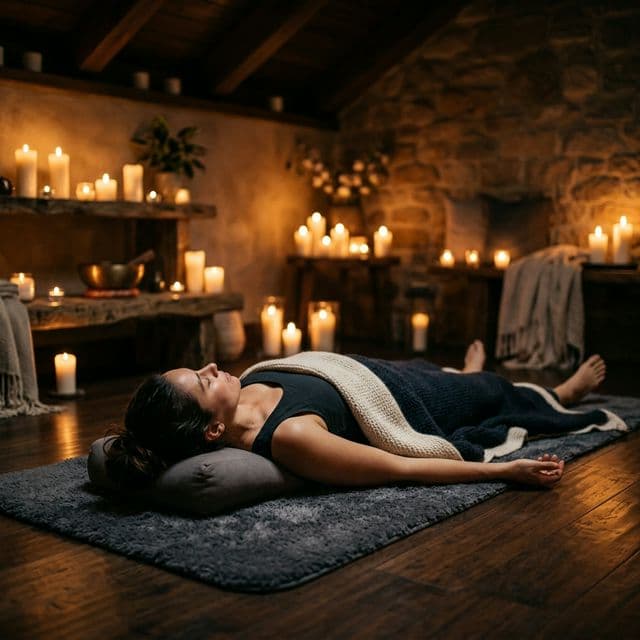
- Dim lighting or candles
- Comfortable temperature (body cools at rest)
- Phone on airplane mode (really)
- Silence or very soft music (no lyrics)
- Timer so you don't watch the clock
The Deep Relaxation Sequence (30-45 min)
- 1
Supported Child's Pose - 5 min
Setup: Place a bolster or pillow between your thighs. Kneeling, sit on your heels and fold forward onto the bolster. Turn your head to one side (switch halfway).
**Support:** Add blanket under knees if sensitive. Cushion between buttocks and heels if needed. **Effects:** Calms the mind, gently stretches the back, comforting fetal position. - 2
Supported Reclined Twist - 5 min each side
Setup: Lying on back, knees bent toward chest. Let knees fall to the right. Place cushion between knees and one under lower knee if needed.
**Support:** Left arm opens, palm to sky. Gaze to left or ceiling. **Effects:** Releases back tension, gentle organ massage, balances nervous system. - 3
Caterpillar / Supported Forward Fold - 7 min
Setup: Seated, legs extended (or slightly bent). Place bolster or stacked cushions on thighs. Fold forward and rest torso/head on support.
**Support:** Blankets under knees. Arms on either side of bolster or over it. **Effects:** Gently stretches back, deeply calming, introspection. - 4
Reclined Butterfly - Supta Baddha Konasana - 7 min
Setup: Lying on back. Bring soles of feet together, knees falling to sides. Place cushion under each knee for support.
**Support:** Bolster under spine (head above) to open chest. Rolled blanket under neck. **Effects:** Opens heart and hips, easier breathing, deeply relaxing. - 5
Legs Up the Wall - Viparita Karani - 8 min
Setup: Sit sideways against wall, then pivot to extend legs up the wall. Buttocks close to wall (or 4-6 inches away if hamstrings are tight).
**Support:** Small cushion under lower back. Arms open or on belly. **Effects:** Reverses circulation, relieves heavy legs, calms nervous system. "Miracle" pose. - 6
Supported Savasana - 10 min
Setup: Lying on back. Bolster under knees (releases lower back). Small rolled blanket under neck. Mask over eyes.
**Support:** Light blanket over body. Palms to sky. Feet fall naturally outward.

**Effects:** Deep integration, total relaxation, cellular regeneration.
Breaths for Relaxation
Diaphragmatic Breathing
The foundation of all relaxation:
- Inhale through nose, let belly expand
- Exhale through nose or mouth, belly empties naturally
- No forcing, just let it happen
4-4-6 Breath
To deepen calm:
- Inhale for 4 counts
- Hold full for 4 counts
- Exhale for 6 counts (long exhale is key)
Practice 5-10 cycles, then let breath be natural.
The Releasing Sigh
Perfect for releasing sudden tension:
- Big inhale through nose
- Exhale through mouth with audible "ahhhh"
- Really let it out
3-5 sighs at start of session to "land."
When to Practice Restorative Yoga
Ideal Moments
- End of day: Work/evening transition
- Sunday evening: Prepare for the week gently
- After a stressful event: Nervous system reset
- During menstruation: Gentle alternative to dynamic yoga
- For insomnia: 20 min before bed
Frequency
- Minimum: Once a week
- Ideal: 2-3 times a week
- Intensive (stress period): Every evening, even 15 minutes
Common Mistakes to Avoid
- 1
Not Enough Props
Restorative yoga needs many cushions, blankets, blocks. If any body part isn't supported, muscles stay engaged to hold it. Better too much support than not enough.
- 2
Poses Too Short
5 minutes minimum per pose. The first minutes, the body still resists. It's after that deep release begins. If you're rushed, do fewer poses longer.
- 3
Disturbing Environment
Phone vibrating, light too bright, cold — all this keeps nervous system on alert. Create a cocoon. Your relaxation depends on it.
- 4
Trying to "Do It Right"
Paradoxically, trying to do well sabotages relaxation. There's nothing to achieve. Drop the ambition. Just be there.
Restorative Yoga vs Yin Yoga
Often confused, but they're different:
| Restorative Yoga | Yin Yoga |
|---|---|
| Zero effort | Passive stretch |
| Body fully supported | Fewer props |
| Muscle release | Fascia work |
| Nervous system | Connective tissue |
| Anytime | Avoid if very tired |
Both are complementary. Restorative to recover, Yin to stretch.
Going Further
Yoga Nidra
"Yogic sleep": a guided lying meditation that induces even deeper relaxation. 30 minutes of Yoga Nidra equals several hours of sleep in recovery terms. Perfect after the restorative sequence.
Progressive Muscle Relaxation (PMR)
Complementary technique: voluntarily contract each muscle group then release. The contrast amplifies the relaxation sensation. Useful when you have trouble "letting go."
FAQ
I can't relax, I'm thinking all the time. Is this normal?
Absolutely normal. The busy mind is exactly what we
I systematically fall asleep. Is that a problem?
If you fall asleep, your body needs it! Restorative yoga sometimes reveals a sleep deficit. Let yourself go. Over time, once the sleep debt is paid, you
Can I practice restorative yoga while pregnant?
Yes, with adaptations. Avoid lying flat on your back after first trimester (vena cava compression). Use cushions to stay on your side or slightly inclined. Certain poses are particularly beneficial during pregnancy.
How do I know if I'm really releasing?
Some signs: natural, deep breathing, pleasant heaviness sensation, losing track of time, slight numbness, startle at the end (indicates near-sleep state). With practice, you
Conclusion
In a world that values constant action, restorative yoga is a revolutionary act. It gives you permission to do nothing, produce nothing, simply be.
This isn't wasted time — it's time invested in your regeneration. Studies show that people who truly rest are more productive, more creative, more resilient.
Tonight, set up your cushions. Dim the lights. And give yourself this gift: 30 minutes where you have absolutely nothing to do but exist.
Guided sessions for total release
Discover our restorative yoga and Yoga Nidra classes, guided by soothing voices. Let yourself be carried to deep relaxation.
Discover restorative yogaKeywords
Ready to transform your wellbeing?
Join thousands who have already started their wellness journey with Retreat & Be.
Start