

Lighting for Home Yoga Studio: Complete Guide for Professional Video
Good lighting transforms amateur video into pro content. Discover how to light your yoga space for professional-quality online classes.
Équipe Retreat And Be
Editorial content produced and reviewed by the Retreat And Be team.
Introduction
You're filming your yoga classes and the result is... disappointing. The image is dark, your face has strange shadows, the colors are dull. You think you need a better camera. In reality, you need better lighting.
Lighting is the secret of videos that seem "professional." And contrary to belief, it doesn't require a huge budget or dedicated space. With the right techniques, you can create quality lighting in any room.
This guide explains everything: the fundamental principles, recommended setups, and how to optimize based on your budget and space.
Video Lighting Fundamentals
The Three Types of Light
- 1
Key Light
This is your dominant light source. It sets the mood and illuminates the main subject (you). It must be powerful enough and well-positioned.
**Ideal position:** At 45° to the side of the camera, slightly above your eyes. - 2
Fill Light
It softens the shadows created by the key light. Without it, you get too much contrast (one side of the face dark).
**Ideal position:** On the opposite side of the key light, less intense (50-70% of key power). - 3
Back Light / Hair Light
It separates the subject from the background, adding depth. It creates a slight halo around your silhouette.
**Ideal position:** Behind you, aimed at your head/shoulders.
Hard vs Soft Light
Hard light: Creates sharp shadows, strong contrasts. Not flattering for portraits. (Direct sun, spot without diffusion)
Soft light: Creates gradual shadows, soft transitions. Flattering, professional. (Indirect natural light, diffused sources)
Color Temperature
Light has a "color" measured in Kelvin (K):
- 2700-3000K: Warm (orange/yellow) — cozy ambiance
- 4000-4500K: Neutral — natural, balanced
- 5500-6500K: Cool (bluish) — daylight
Tip: Choose 4000-5500K for yoga. It's natural and flattering. And most importantly: don't mix sources of different temperatures (it creates zones of different colors impossible to correct).
The Free Option: Natural Light
Why It's Often the Best
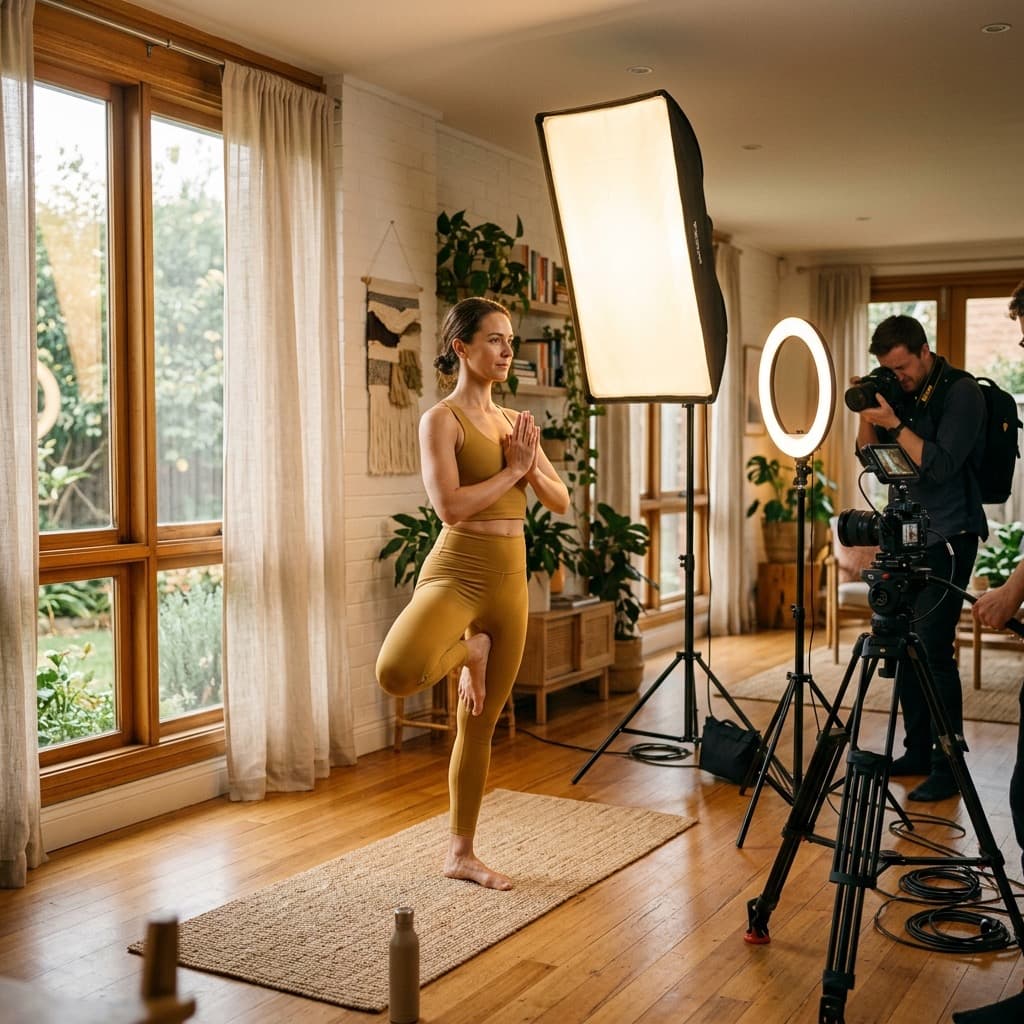
Natural light is free, abundant, and generally flattering. If you have a large window, you may already have your ideal setup.
How to Use It
- 1
Position yourself facing the window
The window becomes your key light. You'll be uniformly lit with beautiful soft light.
**Important:** Never have a window behind you (backlight = dark silhouette). - 2
Use a reflector on the shadow side
A simple white panel (cardboard, board) on the opposite side of the window bounces light back and softens shadows. Improvise with what you have.
- 3
Film at the right time
Natural light changes depending on the time and weather. Ideal hours: mid-morning or mid-afternoon (not direct noon sun, not low evening light).
- 4
Diffuse if necessary
If the sun is direct and creates hard shadows, place a sheer curtain or white fabric in front of the window to diffuse.
Natural Light Limitations
- Inconsistency: Clouds, seasons, time of day — your lighting varies
- Availability: No classes in the evening, no classes in dark weather
- Control: You can't adjust intensity or direction
Artificial Lighting: The Options
Ring Light
For: Uniform frontal lighting, catchlight in eyes, compact, affordable
Against: Can seem "flat" (no depth), strange shadows if poorly positioned
Ideal for: Talking head, close-up shots
Budget: $30-100
LED Panels
For: Versatile, powerful, often adjustable temperature, soft light with diffuser
Against: More bulky, more expensive for quality
Ideal for: Semi-pro setup, wide shot (full body)
Budget: $80-300 per panel (2 panels recommended)
Softboxes
For: Very soft and professional light, large diffusion surface
Against: Bulky, more complex setup
Ideal for: Dedicated studio, high-quality production
Budget: $100-400 per kit (2 softboxes + stands)
Portable LEDs / Tubes
For: Compact, creative, good for ambiance
Against: Less powerful, often used as complement
Ideal for: Backlight, accents, mobility
Budget: $50-150
Recommended Setups by Budget
Minimal Budget ($0-50)
"Enhanced natural light" setup:
- Large window as key light
- White panel/cardboard as reflector (free)
- Film during midday
Result: Very decent if conditions are good
Beginner Budget ($50-150)
"Ring light+" setup:
- 18" ring light ($50-80) as key light, facing you
- White reflector or small LED fill on shadow side
- Optional: small LED behind for backlight
Result: Professional for close-ups, decent for full body
Intermediate Budget ($150-400)
"Two panels" setup:
- 2 LED panels with diffusers ($100-150 each)
- 1 as key (45°), 1 as fill (other side, less intense)
- Optional: small LED for backlight
Result: Excellent for all shot types, versatile
Pro Budget ($400+)
"Complete softbox" setup:
- 2 large softboxes (key + fill)
- 1-2 LEDs for backlight and accents
- DMX controller to adjust everything from an app
Result: Professional studio quality
Configuring Your Space
The Ideal Layout
        [Backlight]
              ↓
           [YOU]
          /     \
    [Fill]       [Key]
     ↑             ↑
   45°           45°
              ↓
         [CAMERA]
Specifically for Yoga
Solutions:
- Light the entire zone, not just one point
- Place lights higher and further away
- Use tall stands (2m+) or ceiling mounts
- Test all your usual movements before filming
Avoiding Common Mistakes
- Lights too low = shadows under eyes (zombie look)
- Light behind you = dark silhouette
- Mixed temperatures = yellow and blue zones
- Lights visible in frame = amateur
- Hard shadows = unflattering, distracting
Settings and Optimization
Adjusting Intensity
- Start with your key light at medium power
- Add fill at 50-70% of key intensity
- Backlight should be subtle (30-50%)
- Adjust until shadows are soft but present (some shadow = depth)
Checking with Your Camera
What your eye sees ≠ what the camera captures. Film a test:
- Watch the result on a computer (not just phone)
- Check for areas too dark or overexposed
- Adjust and repeat until satisfied
Consistency Between Videos
Note your settings (light positions, intensity, camera parameters). Your students appreciate visual consistency between classes.
FAQ
Ring light or LED panels?
Ring light for close-ups and if you
How many lights minimum?
A single well-placed light + reflector can be enough to start. Ideal is 2 lights (key + fill). 3 lights (+ backlight) for a more pro result.
Natural or artificial light?
If you have a beautiful window and can film at ideal hours, natural light is excellent and free. If you want flexibility (filming in evening, in cloudy weather), invest in artificial.
Do I need adjustable temperature lights?
Highly recommended. Bi-color LEDs let you adjust from warm to cool depending on desired ambiance and to match natural light if you combine both.
Conclusion
Lighting is probably the best investment you can make for your video quality. Before upgrading your camera, make sure your lighting is optimized.
Start with what you have: a window, an improvised reflector. Observe the result, identify what's missing. Then invest progressively.
Good lighting doesn't just make the image more beautiful — it makes you more beautiful, more professional, more credible. And your students feel it.
Ready to create pro content?
Retreat & Be offers instructors a streaming platform optimized for wellness. Quality, simplicity, community.
Become a creatorKeywords
Ready to transform your wellbeing?
Join thousands who have already started their wellness journey with Retreat & Be.
Start